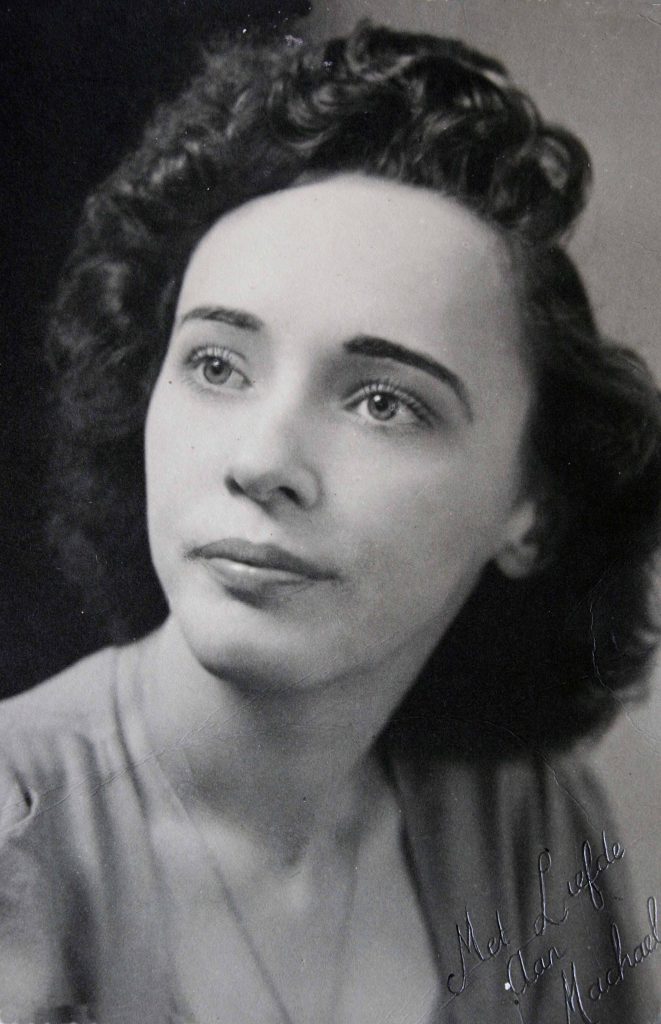
Cornelia Aletta Dreyer
Homemaker, Organiser, Artist, Farmer, Traveller, and Heart of the Family
Story Introduction:
Some women quietly hold entire families together. Not through force or authority, but through energy, warmth, creativity, faith, and an extraordinary ability to keep life moving forward no matter what hardships arrive.
That is how the family remembers Cornelia Aletta Dreyer — known to almost everyone simply as Corrie.
- She was creative.
- Organised.
- Strong-willed.
- Deeply involved in church and community life.
- A gifted organiser of people and events.
- A lover of flowers, gardens, painting, music, and beauty.
Yet beneath all of that warmth was also remarkable resilience. She endured loss, hardship, financial pressure, farming struggles, raising six children, and the sudden death of her second oldest child — and somehow continued building, creating, organising, and caring for others throughout her life.
Cornelia Aletta Dreyer was born on 20 August 1928 on the farm Leeupoort. She was the only child of Jacobus Nicolaas Dreyer and Anna Elizabeth Pretorius Dreyer. Her early years were spent on the farm Leeupoort near Fochville, where she developed a deep love for nature, open spaces, flowers, and rural life. South Africa during her childhood was still deeply shaped by the aftermath of the Anglo-Boer War and the economic hardships of the Great Depression. Farming communities across the western Transvaal lived difficult but close-knit lives centred around church, family, schools, and agricultural survival. Corrie grew up within this world.
She attended primary school at Japiesrust near Leeupoort when she was seven years old. Like many rural schools of the period, it was a small two-teacher farm school serving scattered farming families. Later the school was centralised at Elandsfontein in the Fochville district. Afterwards she attended Volkskool High School in Potchefstroom, staying in the hostel from Standard Six through to matric.
Those years helped shape her independence and confidence. Family stories suggest that she already stood out as energetic, social, creative, and deeply involved in school and cultural activities. The story of how she met her future husband remained one of the great family memories. While attending dances at Blyvooruitzicht, she met a young man who later asked permission to visit her. He arrived with a friend who did not own a motorcar. That friend was Michael van den Berg. At the time he had recently obtained a Royal Enfield motorcycle, which made visiting far easier. Neither realised then that this meeting would shape the rest of their lives.
Corrie became engaged to Michael when she was eighteen years old. He was living at Venterspost and wasted little time before asking for her hand once she turned nineteen.
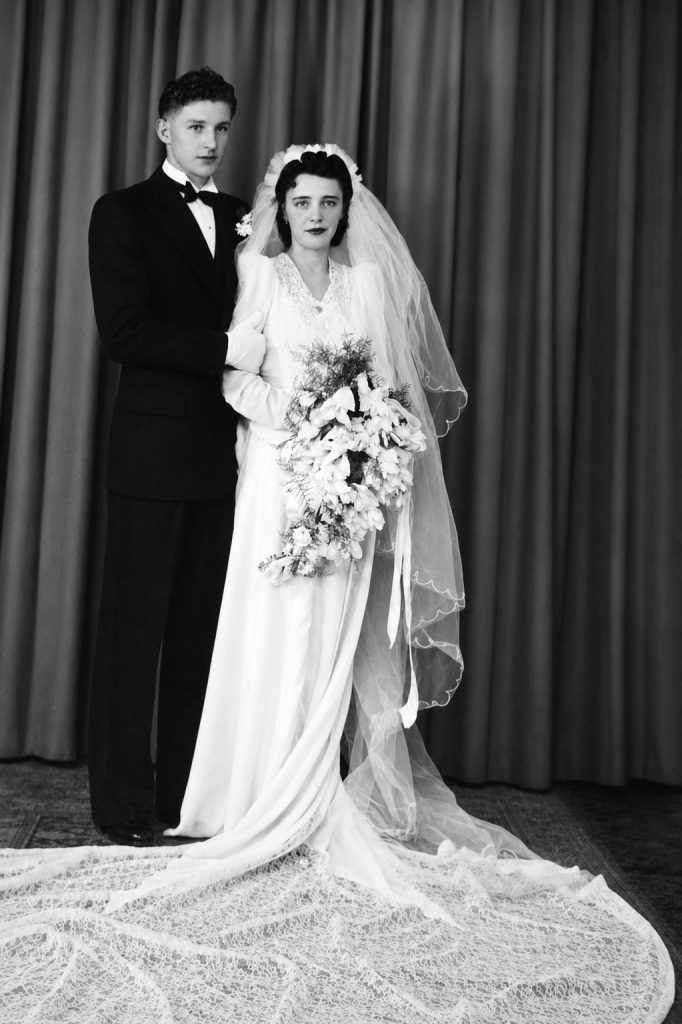
Michael and Cornelia at their wedding
The young couple initially lived for three years with Corrie’s parents on the farm.
Their first children, Elize and Michael, were born while Michael completed his apprenticeship as a fitter.
Those were years of hard work and modest beginnings. Like many South African couples during the late 1940s and 1950s, they slowly built a life together through determination, sacrifice, and discipline. Later the family relocated to Randfontein and settled at 9 Conrad Road in Homelake. They eventually purchased the house and remained there for twenty-three years.
Four more children were born into the family:
- Kobie
- Anette
- Cornelia
- Sagrys
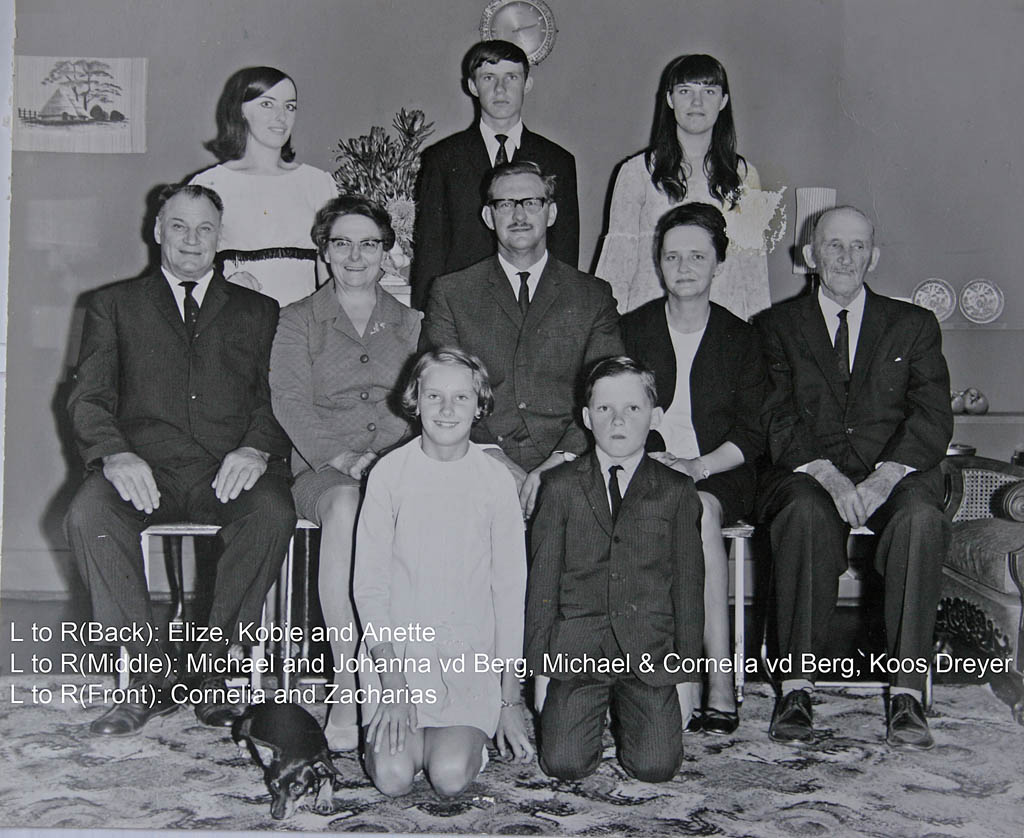
The children attended Randfontein Primary School and later Hoërskool Riebeeck. Corrie became deeply involved in every aspect of family and school life:
– school functions,
– concerts,
– sports meetings,
– fundraising events,
– and church activities.
But she never limited herself only to homemaking. She possessed enormous creative energy. She joined the church women’s association and helped raise funds for the Hervormde Kerk through flower arranging, bazaars, weddings, and countless fundraising projects.
Flower arranging became one of her great passions. She attended formal flower-arranging classes and eventually became well known for her creativity and organisational ability. At one stage, despite having no previous experience, she boldly organised the first flower show in Randfontein. The proceeds helped fund the purchase of an electric organ for the church. The event proved highly successful. Afterwards she organised many additional flower shows and became increasingly well known in the community. She won numerous prizes for her floral arrangements and artistic displays.
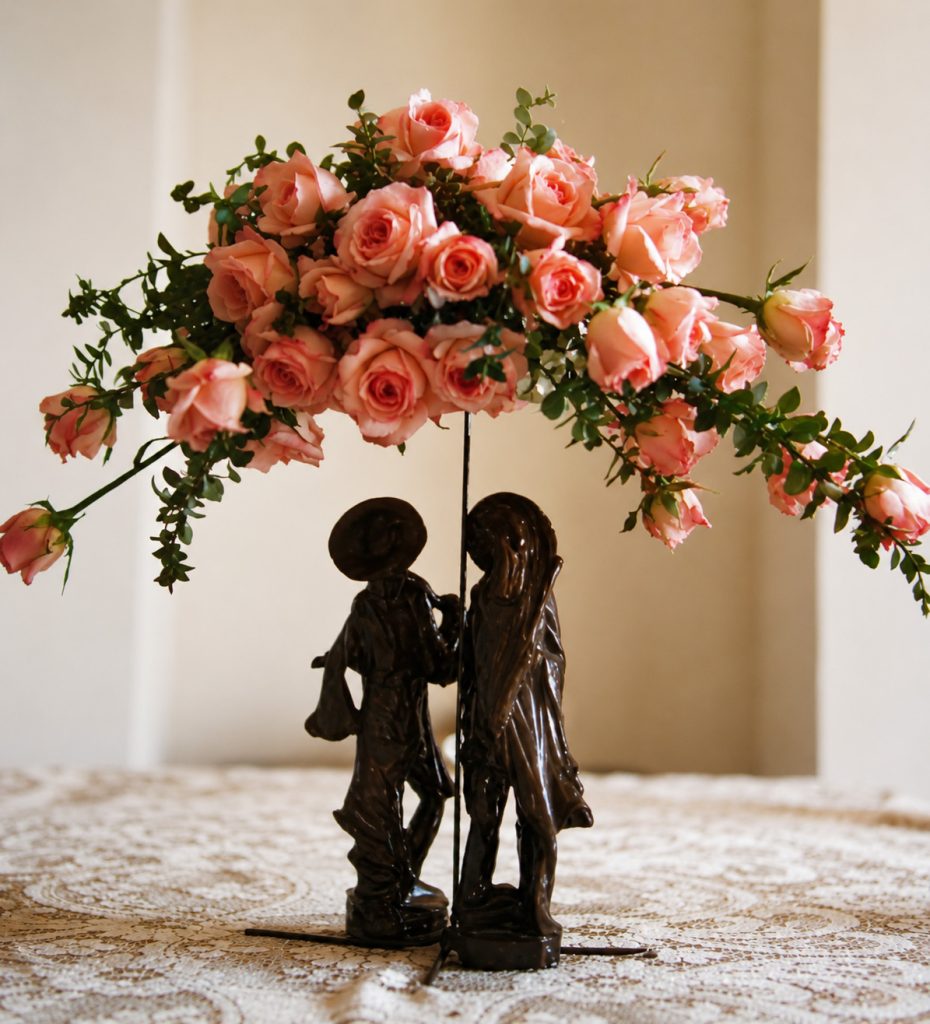
Cornelia`s flower arrangement
At the same time she managed an extremely busy household with six children while supporting her husband’s demanding engineering career, Citizen Force obligations, business ventures, farming interests, and church responsibilities. Few people fully appreciated how much energy this required.
Life, however, also brought deep sorrow. In 1967 she lost her mother.
Then, on 12 November 1969, tragedy struck again when her son Michael Adriaan died in a motorcar accident at only eighteen years of age. It was one of the greatest heartbreaks of her life. Yet even through grief she continued serving her family and community.
Her interests remained remarkably broad. She completed courses in:
- writing
- commercial art
- needlework
- flower arranging
and later served as secretary of the Randfontein flower-arranging club. She also helped establish a women’s target shooting club with the assistance of her husband. Meanwhile Michael’s own career continued expanding. He became increasingly involved in the Citizen Force and was eventually promoted to Colonel within the Witwatersrand area.
By the late 1960s the family began building a new house on the farm Weltevrede outside Fochville. The project took nearly two years to complete. Michael performed much of the building work himself over weekends while the farm income from mealie harvests helped finance construction. The family eventually relocated permanently to the farm in 1972. Those years became some of the happiest in Corrie’s life. Farm life suited her perfectly.
She joined the Landbou Unie women’s cultural association and served on the committee for twelve years, helping organise social evenings, cultural events, and community functions. One event especially remained famous within family memory:
a German-themed evening hosted on their farm. Using her husband’s shed, she transformed the venue with decorations and flags obtained from the German embassy. Guests were served traditional German food including sauerkraut, schnapps, and pickled pork.
She also became deeply involved in the NHSV (Nederduits Hervormde Sustersvereniging), later serving as chairperson. Her church remained central to her entire life. The Fochville Dutch Reformed Church carried deep emotional meaning for her:
- her father had served there as an elder,
- she was baptised there,
- confirmed there,
- married there,
- and three of her children were later married in the same church.
Corrie also possessed an adventurous side. In 1969 she travelled alone to Europe for the first time — something highly unusual for many South African women of her generation. Her husband joined her later from Berlin. Together they travelled extensively through:
- England
- Scotland
- France
- Holland
- Germany
- Switzerland
- Spain
- Italy
- and Egypt.
These journeys broadened her artistic interests and love for culture.
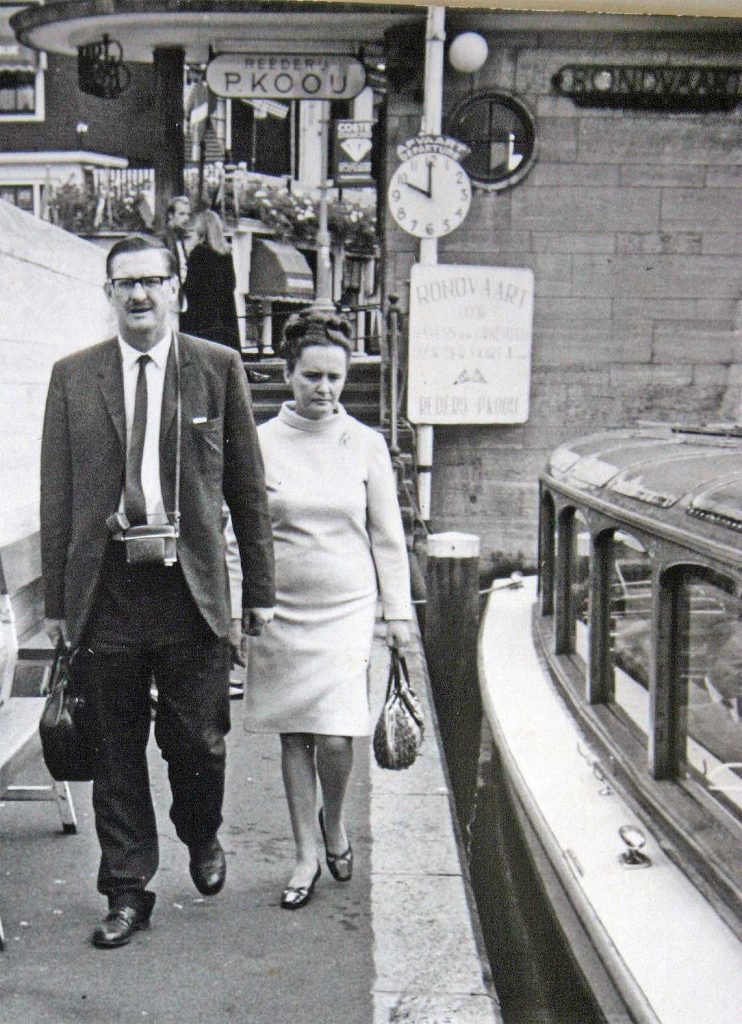
Michael and Cornelia travelling through Europe
Another important part of family life centred around Port Alfred. Michael built a holiday home there in 1976. For twenty years the family spent holidays fishing, relaxing, swimming, and building memories along the Eastern Cape coast. Corrie especially loved having her children and grandchildren gathered together there.
Alongside all her church and cultural activities, she also farmed actively. She managed vegetable gardens and peach orchards, selling peaches to vendors who travelled from areas as far away as Soweto. Even later in life she remained energetic and creative.
In 1984 she began painting seriously and discovered a deep love for art. Her favourite subjects were flowers and nature scenes.
One of her paintings was donated to the Losberg Primary School. To remain active socially she joined the Fochville bowls club in 1985.
Initially she played alone before Michael later joined her. She performed exceptionally well, winning the novice tournament one year and later finishing runner-up in Parys against seventeen competing teams.
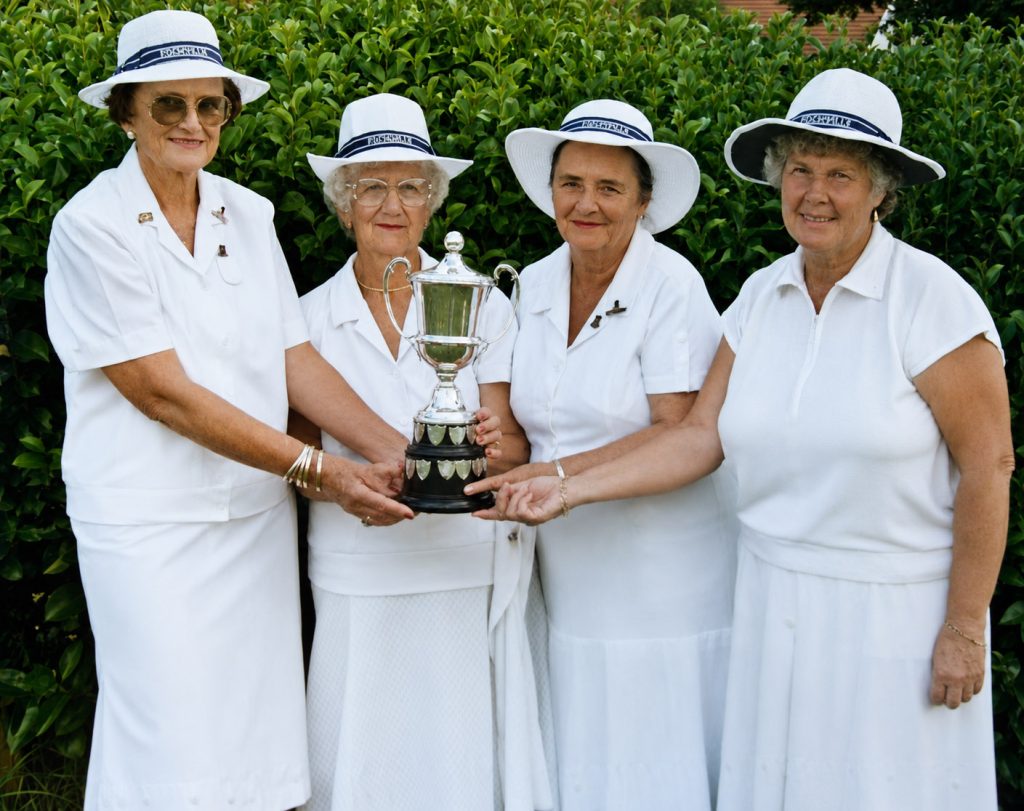
Fochville Bowls Club team photograph, c. 1990s. Cornelia Aletta (“Corrie”) van den Berg is third from the left.
After Michael retired from business, the couple eventually sold the Weltevrede farm to their youngest son Sagrys and relocated to Kanna Street in Fochville. Then tragedy struck once more. During a holiday in Port Alfred in January 1999, Michael suddenly collapsed and died after swimming. His death deeply affected Corrie. Afterwards she sold the holiday house in Port Alfred, moved into a flat in Fochville, and slowly rebuilt her life once again.
She the bought a house in Fochville in the old age home run by the ATKV. She often visited her children that were scattered around South Africa. She regularly flew to Richards Bay to visit her daughter Cornelia. She loved getting out and would join them on excursions to the Game Reserves and even travelling on a boat on the Josini Dam.
When she became more frail she moved in with her youngest daughter Louise and Louise and her husband Gysbert looked after her till she passed away. She was buried in the cemetery in Fochville.
Looking back now, Cornelia Aletta Dreyer’s life reflected much of twentieth-century Afrikaner South African life:
- farming communities
- church culture
- women’s organisations
- family sacrifice
- creativity
- entrepreneurship
- travel
- grief
- resilience
- and the building of strong family foundations.
Through paintings, photographs, flowers, church memories, recipes, travel stories, farming life, and the countless lives she touched through her warmth and energy, the story of Cornelia Aletta Dreyer still survives — a remarkable woman whose creativity, faith, resilience, and love helped shape generations around her.
Timeline:
Documents & Evidence:
Key records and sources connected to the life of Cornelia Aletta Dreyer include:
- Dreyer family records from Leeupoort and Fochville
- School and hostel references from Japiesrust, Elandsfontein, and Volkskool Potchefstroom
- Marriage and family records of Michael and Corrie van den Berg
- Church records connected to the Hervormde Kerk in Fochville and Randfontein
- NHSV and Landbou Unie committee references
- Flower-arranging competition records and photographs
- Family travel memories and European travel references
- Family photographs from Randfontein, Weltevrede, Fochville, and Port Alfred
- Painting and art records
- Bowls club tournament references
- Oral family history preserved by children and grandchildren
Together these records and memories preserve the life of a woman whose creativity, warmth, organisational ability, and deep faith touched every part of her family and community life.
Open Questions:
Despite the large amount of surviving family memory connected to Cornelia Aletta Dreyer, several important questions still remain:
- Are there surviving photographs from the early years at Leeupoort and Homelake?
- Can additional records from the Randfontein flower shows still be located?
- Are there surviving examples of Corrie’s flower-arrangement awards and certificates?
- Can her paintings and artwork be digitally preserved for future generations?
- Are there surviving travel diaries, postcards, or photographs from the European journeys?
- Can more information be found regarding the women’s target shooting club she helped establish?
- Are there additional church records connected to her years of service in the NHSV?
- Can the history of the Weltevrede farm and peach orchards still be documented through photographs or records?
- Are there descendants who still preserve personal memories, recipes, letters, or recordings connected to Corrie van den Berg?