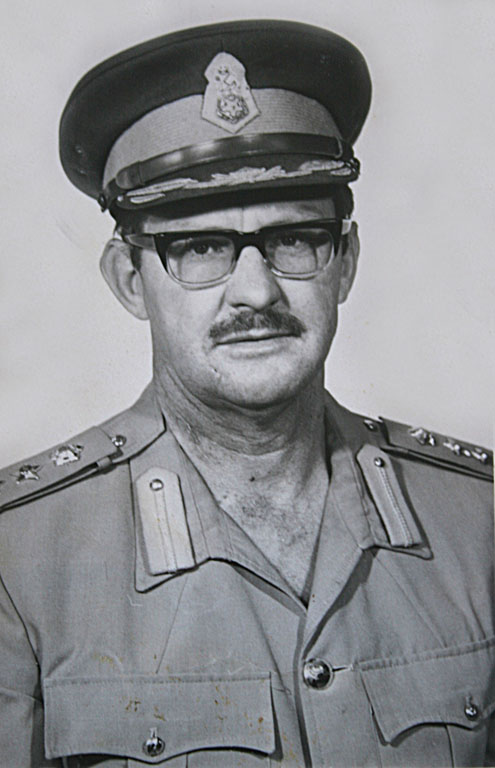
Michael Adriaan van den Berg
Engineer, Farmer, Church Leader, Soldier, and Builder of Communities
Photo Gallery:
Story Introduction:
Some men leave behind businesses. Others leave behind farms, buildings, or achievements.
But a few rare people leave their mark everywhere they go:
– in their family,
– their church,
– their community,
– their work,
– and in the lives of the people around them.
That is how the family remembers Michael Adriaan van den Berg.
- A dynamic man.
- Disciplined.
- Practical.
- Intelligent.
- Deeply committed to his family.
- A natural leader who somehow always found the energy to become involved in yet another project, committee, business venture, church responsibility, or farming activity.
And yet, despite everything he accomplished, family members remember him most for his steadiness, loyalty, and ability to quietly carry responsibility without complaint. Michael Adriaan van den Berg was born on 18 December 1926 in Krugersdorp.
He was the eldest child in the family and grew up alongside a brother and an adopted sister, Anna. His early years were spent on the farm Blyvooruitsig, where he developed a lifelong love for nature, farming, and the quiet rhythm of rural life. South Africa during his childhood was changing rapidly.
The country was emerging from the difficult economic years following the Great Depression while mining and industrial development expanded across the Witwatersrand. Many Afrikaner families moved constantly between farming and mining communities searching for opportunity and stability.
Michael grew up within both worlds:
– the discipline and independence of farm life,
– and the technical, industrial environment developing around the gold mines of the western Transvaal.
He attended a small two-teacher farm school during his early years before the school was later centralised into a larger district school.
Afterwards he attended Volkskool High School in Potchefstroom, where he stayed in the hostel from Standard Six through to matric.
Those years helped shape the discipline that would define much of his later life. The story of how he met his future wife remained part of family memory for decades. Corrie attended dances at Blyvooruitzicht where one evening she met a young man who later came to visit her, bringing a friend along. That friend was Michael van den Berg.
At the time he owned a Royal Enfield motorcycle, which suddenly made visiting far easier. Neither of them realised then that this meeting would shape the rest of their lives. Michael became engaged to Corrie when he was only eighteen years old.
He was living at Venterspost at the time and wasted little time before asking for her hand in marriage once she turned nineteen. Thety got married in the Dutch Reformed Church in Fochville 23 April 1947. The young couple initially stayed with Corrie’s parents on the farm for three years after their marriage.
Their first two children, Elize and Michael, were born there. During those years Michael completed his apprenticeship as a fitter at Venterspost. Technical work came naturally to him.
South Africa’s mining and engineering industries were expanding rapidly during the 1940s and 1950s, creating opportunities for ambitious young men with technical skills and discipline. Michael later transferred to head office in Johannesburg at 17 Fox Street, where he worked as a draftsman and eventually progressed to section leader.
By the mid-1950s the family relocated briefly to Carletonville, where he continued his engineering studies through East Driefontein Mine while completing his pupil engineering training. Although they moved away for a period, the family later returned to Randfontein and settled at 9 Conrad Road, Homelake. That house became the centre of family life for almost twenty years.
Their children:
- Anna (15 Dec 1948)
- Michael (3 Apr 1950)
- Jacobus (22 March 1953)
- Johanna (10 Apr 1955)
- Cornelia (18 Jan 1959)
- Zacharias (5 Jan 1962)
were born in Krugersdorp and grew up in Randfontein.
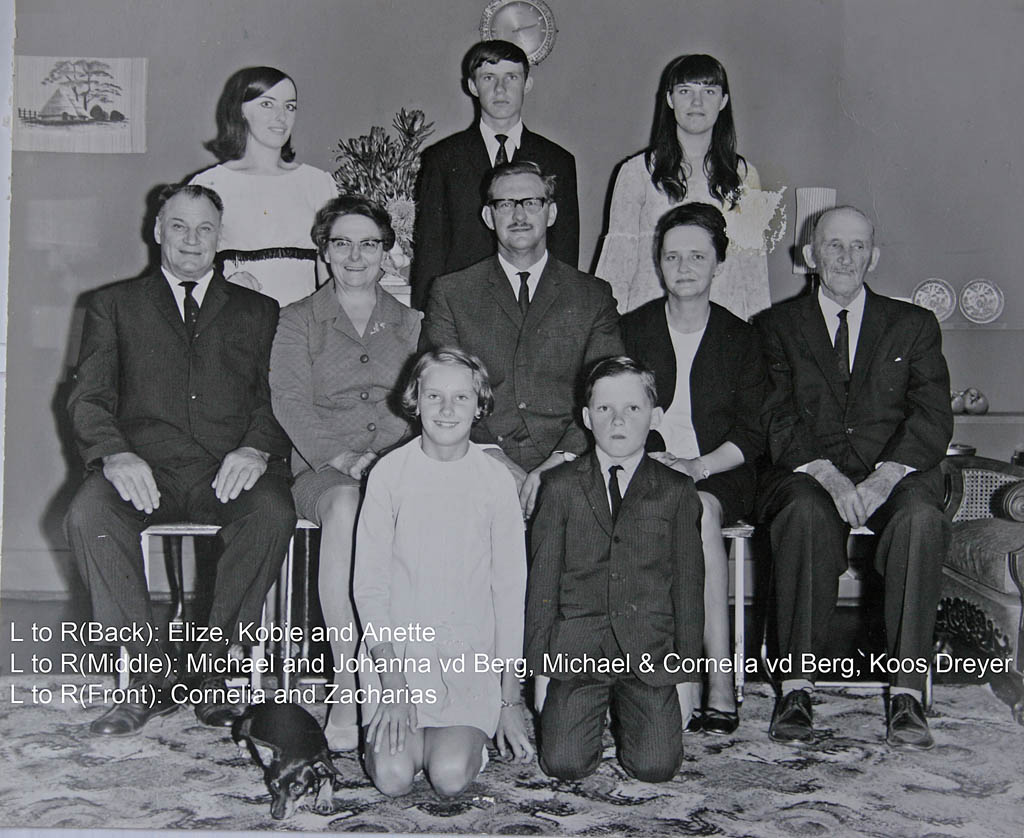
The children attended Randfontein Primary School and later Hoërskool Jan Viljoen and Hoërskool Riebeeck. Michael travelled daily by train to Boksburg for work. Remarkably, family members could never remember him complaining about the long journeys. Instead, he used the travelling time productively:
– reading,
– studying,
– and improving himself.
That quiet discipline became one of his defining characteristics. He completed his Government Certificate of Competency and later worked for Wright Anderson for many years. But work alone was never enough for him. He became deeply involved in church life and community service. The family belonged to the Hervormde Kerk in Randfontein during a period when the congregation was raising funds to build a new church. His wife organised flower shows and fundraising events while Michael served on the church building committee and later as a deacon.
Education also became one of his major commitments. For twelve years he served on the school parent committee and even assisted in designing the school sports fields. At the same time he remained active within the Citizen Force.
Sadly he lost a child Michael 12 Nov 1969, his oldest son died during a motor accident outside Randfontein.
South Africa during the 1950s, 1960s, and 1970s relied heavily on Citizen Force structures, and many professional men balanced careers, church responsibilities, farming interests, and military obligations simultaneously. Michael attended regular meetings and weekly duties connected to army headquarters in Ramsgate.
Yet somehow he still found time for business. Together with Cliff Ramsden he established a company called Tecroveer on 1 March 1976.
The business identified a major need within the South African mining industry for specialised biological sewage treatment systems based on Pasveer ditch principles. What began as a small engineering venture steadily grew into a highly successful and respected company.
In 1984 Tecroveer registered its first proprietary patent, marking an important technological breakthrough. Over the following decades the business expanded from supplying mechanical equipment into providing complete turnkey sewage treatment solutions for municipalities and industry. Long after Michael’s death, the company continued growing and eventually celebrated fifty years of operation in 2026.
Despite his demanding professional life, Michael never lost his love for farming. For many years the family lived on the farm Weltevrede outside Fochville, where he farmed cattle and peaches as a personal passion alongside his engineering career. Farming was not simply a hobby to him. It was part of his identity. Family life remained deeply important. The couple were blessed with another child:
- Louisa (25 May 1976)
For fourteen years he faithfully drove to Ramsgate twice a year in his blue motorcar to visit his parents in Strachan Street. The family loved the coast and especially rock and surf fishing. During the sardine run they travelled in a red Volkswagen to fish from the beaches around Port Shepstone, often hoping to catch salmon from the surf.
In 1976 Michael built a holiday house in Port Alfred. It became the family’s holiday home and one of the centres of family memory for decades. He purchased a ski-boat named Gover together with a Jeep to tow it. Deep-sea fishing became one of his great passions, and many years were spent fishing together around Port Alfred. After fishing trips the family often gathered at the ski-boat club for meals and conversation. Those were happy years.
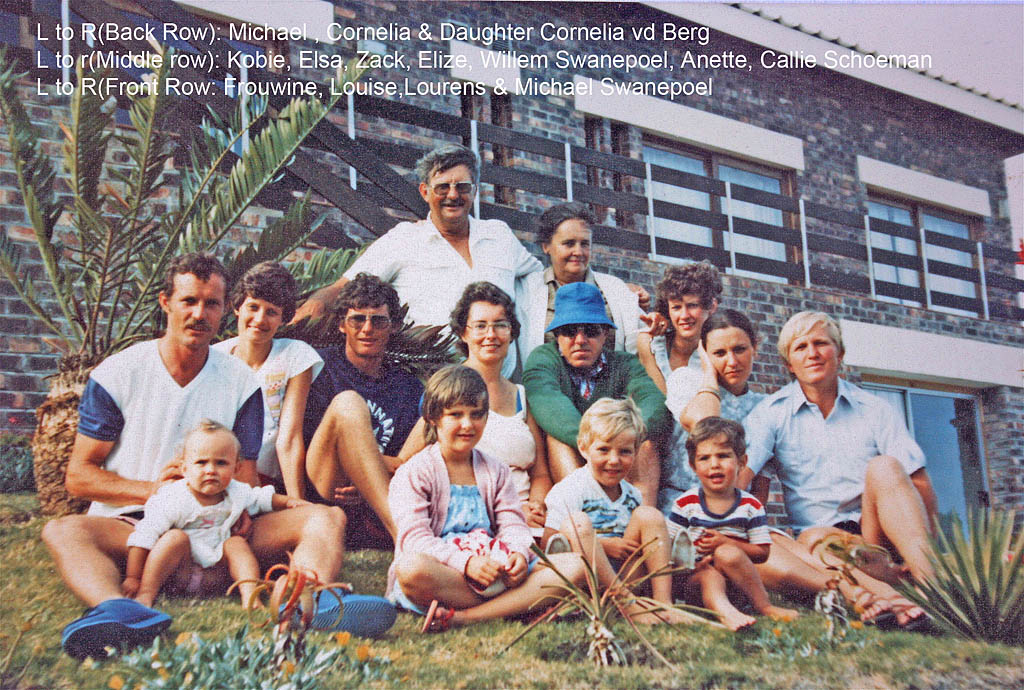
One family memory stood out above many others. During a New Year gathering, his children — Kobie, Sagrys, Cornelia, and their families — washed their parents’ feet and prayed over them, thanking them for the life they had built for the family. It was a moment of deep respect, gratitude, and love.
Only days later tragedy struck unexpectedly. On 5 Jan 1999, after the family had left early that morning, Michael spent the day planting grass and working hard in the garden as usual. He suggested to his wife that she should go play bowls. When she declined, he suggested they rather go for a swim. He swam with his youngest daughter Louise.
After climbing the steep stairs back from the beach, he suddenly collapsed. An ambulance rushed him to hospital, but he died on the way.
Looking back now, Michael Adriaan van den Berg’s life reflected much of twentieth-century South African history:
- mining expansion
- engineering development
- church building
- Citizen Force service
- Afrikaner community life
- farming
- entrepreneurship
- and the growth of family businesses.
Through photographs, engineering records, church memories, family stories, fishing trips, farming life, and the successful company he helped establish, the story of Michael Adriaan van den Berg still survives — a disciplined and energetic man who constantly built, served, led, and created wherever life placed him.
Timeline:
| Year | Event |
| 18 Dec 1926 | Michael Adriaan van den Berg born in Krugersdorp |
| 1930s | Grew up on the farm Blyvooruitzicht |
| 1940s | Attended Volkskool High School in Potchefstroom |
| c.1944 | Became engaged to Corrie at the age of 18 |
| 23 Apr 1947 | Married Corrie |
| Late 1940s | Completed apprenticeship as a fitter at Venterspost |
| Early 1950s | Transferred to head office at 17 Fox Street, Johannesburg |
| 1955 | Relocated temporarily to Carletonville for pupil engineering training at East Driefontein Mine |
| 1950s | Family settled at 9 Conrad Road, Homelake, Randfontein |
| 1950s–1970s | Worked for Wright Anderson |
| 1950s–1970s | Served on church building committees and as a deacon in Randfontein |
| 1950s–1970s | Served for 12 years on school parent committees |
| 1950s–1970s | Active in the Citizen Force |
| 1950s–1970s | Active in the Citizen Force |
| 1 Mar 1976 | Co-founded Tecroveer with Cliff Ramsden |
| 1976 | Built family holiday house at Port Alfred |
| 1984 | Tecroveer registered its first proprietary patent |
| Later years | Farmed cattle and peaches on Weltevrede farm near Fochville |
| 5 Jan 1999 | Michael collapsed after swimming at Port Alfred and died on the way to hospital |
| 2026 | Tecroveer celebrated 50 years of operation |
Documents & Evidence:
Key records and sources connected to the life of Michael Adriaan van den Berg include:
- Family records and oral history preserved by the van den Berg family
- Apprenticeship and engineering references connected to Venterspost and East Driefontein Mine
- Employment records linked to Wright Anderson
- Church committee and deacon references from Randfontein
- School parent committee records
- Citizen Force service memories and army references
- Tecroveer company history and patent registration records
- Family photographs from Randfontein, Fochville, Ramsgate, and Port Alfred
- Fishing and farming memories preserved by children and grandchildren
- Personal recollections connected to Weltevrede farm and Port Alfred holidays
Together these records and memories helped preserve the life of a man whose energy, leadership, discipline, and faith left a lasting impact on both his family and the wider community.
Open Questions:
Despite the large amount of family memory preserved about Michael Adriaan van den Berg, several important questions still remain:
- Can the exact dates of his marriage and later engineering qualifications still be confirmed?
- Are there surviving Citizen Force records connected to his military service?
- Can additional records from Wright Anderson and East Driefontein Mine still be located?
- Are there surviving design plans connected to the church sports fields he helped create?
- Can the early engineering drawings and patents from Tecroveer be digitally preserved?
- Are there surviving photographs from the Port Alfred holiday years and ski-boat trips?
- Can more information be found regarding the early years of Tecroveer and its development within the mining industry?
- Are there surviving diaries, notebooks, or technical papers connected to his engineering career?
- Can additional oral histories from family members still be recorded while those memories survive?